How to write a video production brief: the agency checklist
Agency Partners·9 min read
The video production brief is the least glamorous document on the job and the most expensive one to get wrong. A thin brief turns into reshoots, extra revision rounds and a client who quietly stops trusting your timelines. Here’s the checklist I wish every agency sent: copy it, fill it in, and your partner can quote it, plan it and shoot it right the first time.
Why a bad video production brief burns budget
Every producer has lived this one. The brief says “brand video, fun, not too long.” The shoot happens. The first cut goes out. Then the client mentions the vertical cutdowns for paid social, the legal line that has to sit on screen and the CEO who was supposed to be in it.
That’s not a creative problem. It’s a briefing problem, and a 2021 IPA and BetterBriefs study of 1,700+ respondents put a number on it:
The same study found a gap wide enough to park a grip truck in: 80% of marketers think they write good briefs, and 10% of agencies agree (IPA, 2021). Agencies sit right in the middle. Your client briefs you, you brief your production partner, and every handoff is a chance for something to fall off the truck.
The fix is boring, and it works: a brief that answers your partner’s questions before they ask them. Here it is, section by section. Copy the headings into your own video brief template.
The problem, the ask and the audience
Start with why the video exists. If you can’t write this part in plain English, you’re not ready to book a crew.
The business problem and the one action
- The problem: what isn’t working right now. Lost bids, a thin membership pipeline, a hiring crunch, a launch nobody has heard of.
- Why now: the campaign, event or deadline this video is tied to.
- The one action: the single thing the viewer should do next. Book a call, apply for the job, request a tour, shortlist the contractor.
- Success: the metric or outcome the client will judge the video on.
A video can’t do five jobs. Pick the one that pays.
Audience
- Who’s watching: title, industry and how much they already know about the client.
- What they believe now: the objection or assumption the video has to move.
- Where they’ll watch: a phone mid-scroll, a pitch meeting, an event screen, a careers page.
Deliverables, aspect ratios and specs
This section decides the quote, the shot plan and the edit schedule, so get specific. “A video plus some social” isn’t a deliverables list. It’s a future argument.
Length and shape matter. Wyzowl found that 71% of marketers think 30 seconds to 2 minutes is the most effective length (Wyzowl, 2026). Vertical keeps climbing, too: vertical 1080x1920 uploads were up 24%, and shorter videos get higher engagement (Wistia, 2026). Plan cutdowns before the shoot, so the shooter protects the frame for 9:16 instead of cropping a wide shot into mush later.
The deliverables list
- Hero video: working title, target length and primary platform.
- Cutdowns: how many, how long and what each one is for: paid, organic, recruiting, an event loop.
- Aspect ratios: 16:9 for web and YouTube, 9:16 for vertical placements like Reels, Shorts and TikTok, 1:1 wherever a placement calls for square.
- Captions: burned in, a separate caption file, or both.
- Thumbnails and stills: custom thumbnails, plus frame grabs for the case study.
Distribution and delivery specs
- Where it runs: website, YouTube, paid social, LinkedIn, an event screen, a pitch deck.
- Specs and delivery: runtime or safe-zone limits from the media buyer, file formats, naming and where files land.
Mandatories, story and tone
Mandatories are what get a cut rejected at the finish line. Put them in the brief, not in the round-one notes.
Mandatories
- Brand guidelines: the current brand book, fonts, colors and any rules for logos in motion.
- Logo and end card: approved logo files, end card copy, URL and call to action.
- Legal lines: disclaimers, license numbers, trademark notes, anything counsel wants on screen.
- Music restrictions: licensed tracks only, no lyrics under dialogue, a sonic logo, or tracks the client already owns.
- Hard no’s: competitors, products, people or places that can’t appear.
Story and tone references
Adjectives don’t survive the trip from your inbox to a shot list. “Cinematic” and “authentic” mean something different to everyone who reads them. Send links instead, and say what to take from each one: pacing, interview style, music, color. Pull from anywhere, including our construction and club films. Then add one reference the client can’t stand, and say why. It’s often the most useful link in the brief.
Talent, locations, safety and drone
This is where schedules die. Access, releases and airspace all take lead time, and none of them can be fixed in the edit.
On-camera talent and releases
- Who’s on camera: names, titles and roles for every interview, plus anyone likely to be in the background.
- Who does the asking: the person who invites talent, confirms times and handles no-shows.
- Releases: who drafts them, who collects them and whether the client already has release language.
- Nerves: flag anyone uneasy on camera. Non-actors are fine; we coach every interview.
Releases reach further than faces. Adobe Stock’s guidelines call for a model release when a person “can be recognized in any way, by their face, voice, tattoos, clothing, or even specific surroundings” (Adobe Stock). For consent at clubs, see our guide to filming at a private club with privacy and discretion. This is general information, not legal advice; have the client’s counsel approve release language.
Locations, access and safety
- Addresses and access: every location, parking, load-in and the hours the crew can be there.
- Site contact: a named person on site with a cell number, not a front desk.
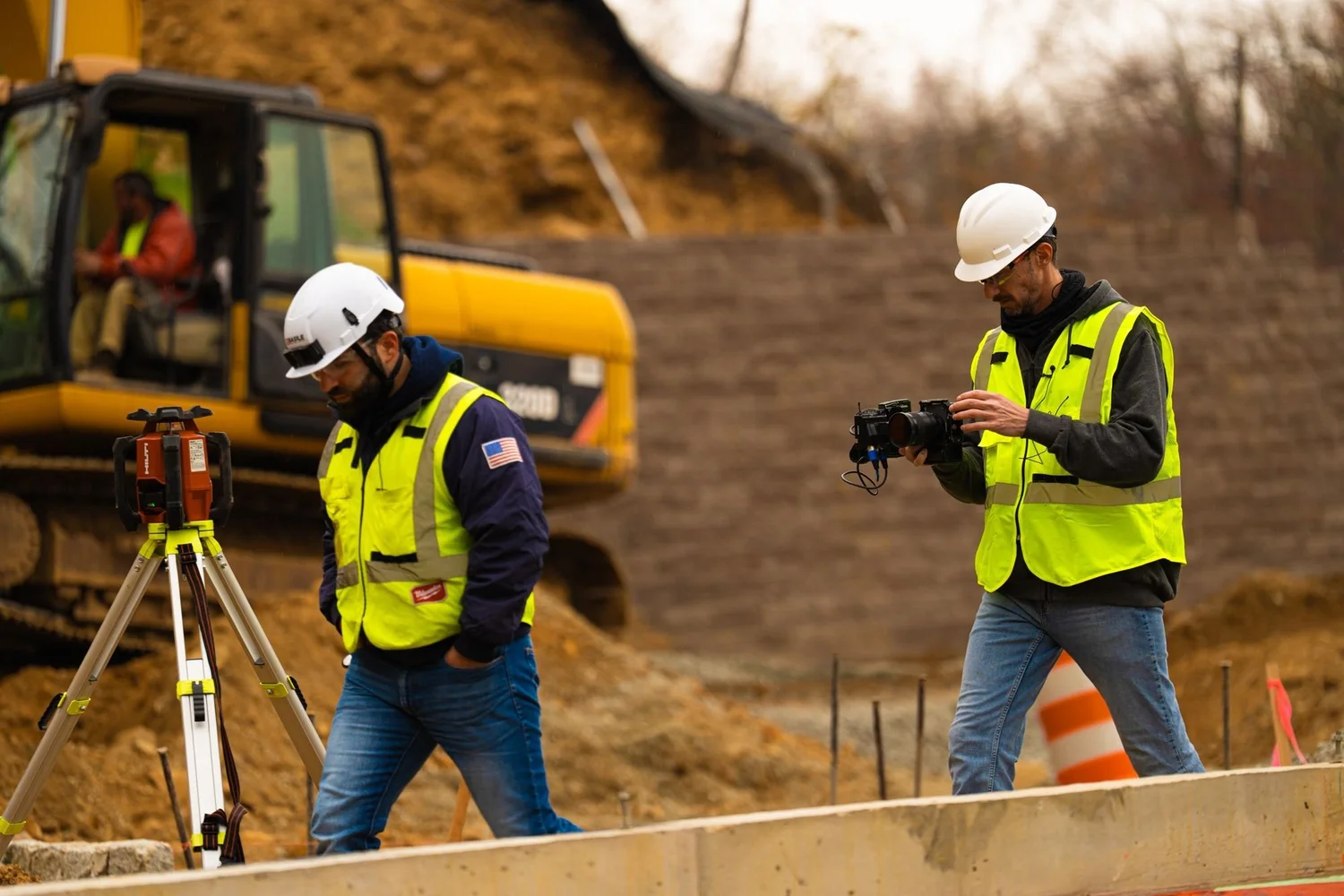
- Jobsites: required PPE, the site orientation or safety briefing, and off-limits zones. I’m OSHA-30 certified, but every site has its own rules.
- Clubs: the general manager’s approval before the crew arrives, plus member areas and tee times to avoid.
Drone
- Shots: reveals, progress passes, top-downs, and what each one has to show.
- Pilot: an FAA Part 107 certified remote pilot. On our shoots, that’s me.
- Airspace: check each site on the FAA’s UAS Facility Maps and request authorization through LAANC where it’s required.
- People below: who will be under the flight path, and whether they’re part of the operation. Flights over people have their own FAA rules.
Under 14 CFR Part 107, a drone flies at or below 400 feet above ground level unless it’s within 400 feet of a structure and no higher than 400 feet above its top, stays within visual line of sight, and needs ATC authorization in Class B, C or D airspace or a Class E surface area. Not legal advice: confirm airspace for every site before anyone promises aerials.
Schedule and approvals
Work backward from the date the video has to be live. If there’s a launch, an event or a premiere, that date runs the whole schedule.
Schedule
- Live date: when the video gets published, screened or handed to the media buyer.
- Shoot dates: first choices, plus a weather backup for anything outdoors.
- First cut: ours lands within 20 business days of the last shoot. Rush is possible, so put the real deadline in the brief.
- Review rounds: we include one round of revisions per deliverable and quote any extra rounds before we start.
- Final delivery: the date files are due, with room for the client’s own approvals.
Approvals
- Agency sign-off: the one person at the agency who approves cuts and consolidates notes.
- Client sign-off: the final decision-maker, plus anyone else who has to see it: legal, an owner, a board.
- Feedback format: one consolidated document per round with timecodes, not a reply-all thread.
- Turnaround: how long the client needs to return notes, so it lives in the schedule.
The most expensive note comes from the stakeholder who never saw round one. Name every approver in the brief, and one clean round of revisions goes a long way.
Budget: share a range
This is the line agencies love to leave blank. Don’t. A range isn’t an invitation to spend all of it. It tells your partner which version of the idea to scope: a single videographer at one location, or a full crew with a sound mixer, gaffer, grip and second camera plus motion graphics. Here’s how agencies plug us in for production days, post or finished videos.
- The range: a floor and a ceiling for production, even a rough one.
- What’s inside it: whether it covers talent, locations, travel and music, or production only.
- Where there’s flex: the deliverables you’d cut first if the quote comes back high.
Without a range, a partner has to guess, and a guess is either too thin for the brief or too heavy for the client. As for what it costs with us: it depends on scope. Tell us about the project and we’ll quote it.
What a partner should send back
A brief starts the conversation. A good video production partner answers it with work of their own, and if all you get back is a number and a “sounds great,” keep looking.
- Questions. Sharp ones, about the gaps in your brief. Proof they read it.
- A shot list. Scene by scene: interview subjects, b-roll, drone passes and which shots protect for vertical.
- A schedule. Shoot dates, first cut, review rounds and final delivery, built back from your live date.
- A fixed quote. Tied to the deliverables list, with what’s included and what isn’t.

That’s the process behind every white-label shoot we run for agencies. New to working with a partner? Start with our guide to white-label video production for agencies, then send the brief. Let’s make something loud.
Video production brief FAQ
What should a video production brief include?
The business problem and the one action you want viewers to take, the audience, a full deliverables list with lengths and aspect ratios, mandatories, references, talent and releases, locations and access, drone needs, the schedule, approvers, distribution specs and a budget range. If a partner would have to ask about it to quote the job, it belongs in the brief.
What’s the difference between a creative brief and a video production brief?
A creative brief for video covers the idea: the problem, the audience, the message and the tone. A video production brief adds everything a crew needs to execute it: deliverables, specs, locations, access, talent, schedule, approvals and budget. Agencies usually need both, and the production brief can simply attach the creative one.
Is there a video brief template I can copy?
Yes. Use the checklist sections in this post as your video brief template: copy each heading into a doc and answer every item under it. Anything you can’t answer yet, mark “TBD” so your partner knows to ask about it on the call.
Should an agency share its budget with a video production partner?
Share a range. It tells the partner which version of the idea to scope, from a single videographer at one location to a full crew with motion graphics, and it keeps quotes from coming back too thin or too heavy for the brief. Say what the range includes, such as travel, talent or music.
How long does it take to get a quote after sending a video brief?
With us, I reply within one business day with a few questions, we get on a 20-minute call, and you get a fixed quote within a week of that call. The more complete the brief, the fewer questions stand between you and that quote.
Sources
- IPA, BetterBriefs research on briefing, 2021
- Wyzowl, Video Marketing Statistics 2026, 2026
- Wistia, 2026 State of Video, 2026
- Adobe Stock, Model release overview (accessed 2026)
- eCFR, 14 CFR Part 107: Small Unmanned Aircraft Systems (accessed 2026)
- FAA, UAS Facility Maps (accessed 2026)
- FAA, Low Altitude Authorization and Notification Capability (LAANC) (accessed 2026)
- FAA, Operations over people (accessed 2026)